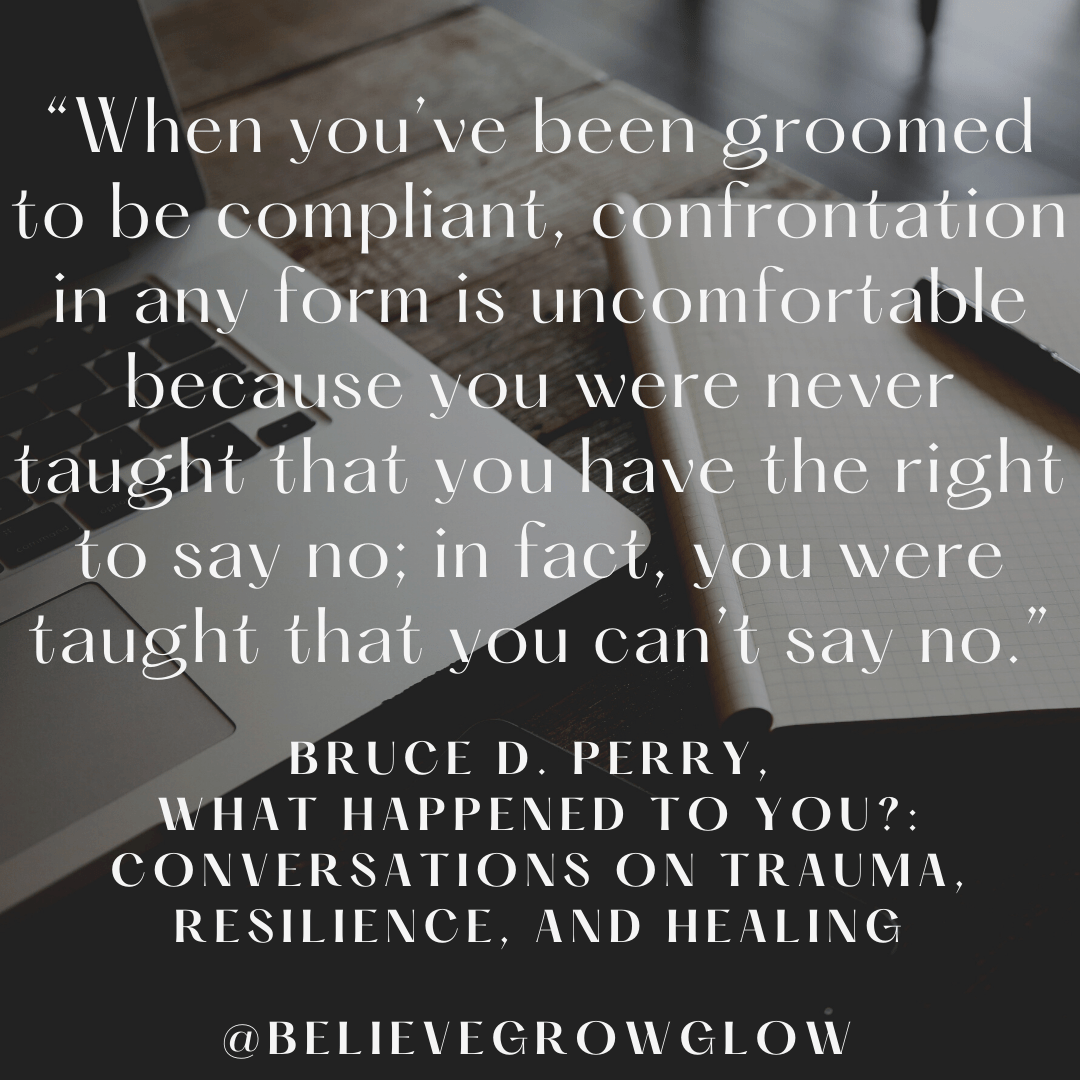
As a child I learned to put others’ needs before my own and was not taught how to have safe boundaries. [If you haven’t yet, please read this post.]
The only way this was done overtly physically was that if an adult (mom, aunt, uncle, etc.) wanted a hug “No” wasn’t an acceptable answer. In their minds it was just a hug, what’s wrong with a hug? It’s an affectionate and loving gesture. The story that was unintentionally reinforced however was “You are not in control of your body. How the other person feels is more important than how you feel.”
I was taught to put others’ needs before my own with statements such as “it would make them really happy (if you did it)” or “it will make them really sad (if you didn’t)” until giving in. Or if I didn’t give in, I was continually made to feel guilty and like I was bad.
This applied to hugs, but also to other things that made me sad or uncomfortable where the adults around me did not have the emotional awareness or intelligence to recognize what they were doing.
The first major self-betrayal I can remember vividly was when I was around 6 years old. I think I was about 6 because my brother was a toddler. My mom was with/married to his dad who was an angry and scary man from ~ 3 years old to 8 years old. He was the kind that gruffly threatened “if you want to cry I’ll give you something to cry about” if you ever showed negative emotions in front of him. The threat of violence if you displeased him was clear so I learned to be small and quiet or avoid being around him. He was only interested in his own biological children. My mom, due to her own trauma and being codependent, made her entire life about him and his wants. I felt chronically unsafe and like an outsider in my own house (which was constantly changing). My sister and I referred to him by his last name. This caused my brother to do the same. My mom pulled me aside and told me how sad it made him that his son didn’t call him Daddy. She told me I was the big sister and my brother looked up to me. If I would start calling him Daddy then my brother would pick it up and do the same. I still remember standing outside the restaurant where they worked the first time I called a man who terrified me “Daddy” so that he would feel better. I still remember the way it felt. Like everything inside me wanted to keep the words in and I wanted to throw up.
When I did get old enough to speak up about being made to feel sad or negative feelings by the way I was treated I was told I had to forgive and love anyway because that’s what you do with family.
Fast forward to my first serious relationship and physical intimacy. The first time I consented to have sex was an act of self-betrayal. I did so with the thought “It’s just your body, what does it matter if it would make him happy?” despite not actually wanting to do it. When I remember that moment, I see it as if I’m watching from someone else’s POV. This is what trauma looks like. By the end of the relationship I was suppressing panic attacks when he touched me. I had never learned how to say no.
It’s hard to explain this to someone who has never lived it, but I find myself more and more in conversation with others who share this experience. If this is you, I want you to know that you are not alone. And that you don’t have to continue living this way. You don’t owe anybody physical affection. Their emotional discomfort over rejection or not getting what they want is not more important than how you feel. The only reason to be intimate with someone is because you want to and it makes you feel good.
When I was married, I frequently had the urge to shove my husband off of me or to hit him when we were intimate. I did not understand why and I felt so ashamed. I continuously wondered “What kind of wife has these urges?” and thought I was a terrible person.
In the beginning of our relationship I agreed to have sex because I felt like we had been together for long enough that he deserved it. Reviewing journal entries about conflict early in the relationship I can see how my wants and feelings were repeatedly disregarded and belittled from the start. Not long into the relationship I began to suffer from vaginismus, which was unfortunately belittled by both my OB (“It’ll get better after you have kids”) and therapist (“Have you tried having a glass of wine before to relax?”). My body knew what my conscious mind did not.
Sex became extremely painful, but my partner continued to guilt me into meeting his needs despite the impact it had on me. I explained the pain and how I felt, but he continued to push. I self-betrayed by putting his needs above my own, even to the point of hurting myself physically, for years. I had never learned what it was to have someone respect me so while I was angry and hurt, I did not set proper boundaries or end the relationship as I should have. By the end of our relationship I had been forcing myself to be intimate with someone I did not feel safe or loved with out of a sense of obligation for a decade. When I tried to address issues around intimacy I was shamed and blamed for being “difficult to have sex with” and “not really a sexual person.” Attempts to remove blame and work towards a solution together were ignored.
I’m happy to report that with a partner who makes me feel safe I have disproved those stories. I no longer experience sexual disfunction. I think it’s important for people to know this if they are currently experiencing something similar. You are not broken. Issues with intimacy in a relationship are never just one person’s problem to fix. Your partner needs to meet you with empathy, compassion, and a willingness to work together to make your relationship the best it can be.
Your body, intuition, and subconscious urges are important warning signs if you know how to listen to them. When as a child you are continuously taught to suppress and ignore your feelings, and that it’s okay for people who “love” you to hurt or ignore you, you get used to feeling the red flags all the time. They no longer serve as a sign that something is wrong. That’s just “normal.”
In addition to the symptoms of post-traumatic stress disorder, an individual with C-PTSD experiences emotional dysregulation, negative self-beliefs and feelings of shame, guilt or failure regarding the trauma, and interpersonal difficulties.
https://en.wikipedia.org/wiki/Complex_post-traumatic_stress_disorder
For a long time I had a story in my head that I was lucky to be in that relationship because I was difficult to love and he put up with me. When I considered leaving I felt guilty because he hadn’t “done anything bad enough to deserve being left.” Only in hind-sight could I recognize how the bar for that was physical violence or an affair. Because I had seen so many examples of bad relationships in my life I felt like mine was so much better by comparison. I was afraid to lose it because I did not believe in anything better.
If you find yourself in a situation where you are uncomfortable or unhappy, notice if you are putting equal weight on your feelings and the feelings of the other person.
It took me a long time to ask myself what I really want, to recognize what I deserve, and then to respect that by taking action. Creating and upholding boundaries is a learned practice and I’m still learning.
What level of expectation do you have for yourself and your partner? When/where did you learn it?
Recommended books to learn about and heal from trauma:
The Body Keeps the Score
What Happened To You?
How to Do The Work
 Believe Grow Glow